Showing posts with label IoT Sensors. Show all posts

Friday, July 10, 2015

Mobile Sensing Wearables Market to Reach $47 Billion in 2018

ELECTRONICS.CA PUBLICATIONS announces the availability of a new report entitled “Mobile Sensing Wearables – Market Dynamics Report”.  Annual revenues for mobile sensing wearables – fashionable devices that perform sensing and location functions—will be $47 billion in 2018 driven by widespread adoption of advanced mobile sensing smart watches. Wearable sensors enabled by low power wireless components, mobile apps, cloud computing and a receptive fashion industry has created a technology tsunami for developers and investors.


“Over the past two years, wearables have gone from a niche market to a revolutionary force,” says Mareca Hatler, ON World’s research director. “Developers from all major industries are seeing opportunities for sensor enabled wearables, integrated cloud applications and services as well as the next fashion trend.”


Over the next five years, 700 million wearable tech devices will be shipped for a global annual market worth $47.4 billion at this time. Hardware will make up the majority of the revenues during this period but mobile apps and subscriptions will grow faster. The wearables industry will rapidly create new fashion lines and this is where manufacturers will break new ground.


With over 400 unique products, the mobile sensing wearables market tripled in 2013 over the previous year and continues to accelerate with the emergence of new product categories such as smart watches, smart glasses, consumer wearable sensors as well as growing industrial and enterprise solutions. Out of the 70,000 product reviews that ON World evaluated, 60% were completed in 2013 and the first quarter of 2014. Some categories such as smart watches have increased by a factor of ten and personal sensors increased by over 500 percent.


ON World has identified over 50 smart watch vendors including sports watches, luxury watches and offerings for children such as the HereO GPS watch. By contrast, there are only about a dozen smart glasses developers but they are on track to become a $5 billion market by 2017. A few other emerging mobile sensing wearable product categories include bracelets (e.g., Cuff and Netatmo), baby vital sign monitors (e.g., Rest Devices, Owlet and Enmovere) and pet activity/location trackers (e.g., Tagg, Voyce and Whistle). Investment in wearables hardware companies is accelerating with almost $500 million invested in 2013 alone.


Sensor fusion and cloud based software and services has become the next “killer” platform. Nest’s recently launched developer program is already showing the potential for integrating wearables with smart home systems such as Jawbone’s UP fitness tracker with Nest’s smart thermostats.


Mobile Sensing Wearables MarkeDetails of the new report, table of contents and ordering information can be found on Electronics.ca Publications’ web site.  View the report:  Mobile Sensing Wearables – Market Dynamics Report.


Mobile Sensing Wearables Market to Reach $47 Billion in 2018

Friday, May 29, 2015

Mobile Sensing Wearables Market to Reach $47 Billion in 2018

ELECTRONICS.CA PUBLICATIONS announces the availability of a new report entitled “Mobile Sensing Wearables – Market Dynamics Report”.  Annual revenues for mobile sensing wearables – fashionable devices that perform sensing and location functions—will be $47 billion in 2018 driven by widespread adoption of advanced mobile sensing smart watches. Wearable sensors enabled by low power wireless components, mobile apps, cloud computing and a receptive fashion industry has created a technology tsunami for developers and investors.


“Over the past two years, wearables have gone from a niche market to a revolutionary force,” says Mareca Hatler, ON World’s research director. “Developers from all major industries are seeing opportunities for sensor enabled wearables, integrated cloud applications and services as well as the next fashion trend.”


Over the next five years, 700 million wearable tech devices will be shipped for a global annual market worth $47.4 billion at this time. Hardware will make up the majority of the revenues during this period but mobile apps and subscriptions will grow faster. The wearables industry will rapidly create new fashion lines and this is where manufacturers will break new ground.


With over 400 unique products, the mobile sensing wearables market tripled in 2013 over the previous year and continues to accelerate with the emergence of new product categories such as smart watches, smart glasses, consumer wearable sensors as well as growing industrial and enterprise solutions. Out of the 70,000 product reviews that ON World evaluated, 60% were completed in 2013 and the first quarter of 2014. Some categories such as smart watches have increased by a factor of ten and personal sensors increased by over 500 percent.


ON World has identified over 50 smart watch vendors including sports watches, luxury watches and offerings for children such as the HereO GPS watch. By contrast, there are only about a dozen smart glasses developers but they are on track to become a $5 billion market by 2017. A few other emerging mobile sensing wearable product categories include bracelets (e.g., Cuff and Netatmo), baby vital sign monitors (e.g., Rest Devices, Owlet and Enmovere) and pet activity/location trackers (e.g., Tagg, Voyce and Whistle). Investment in wearables hardware companies is accelerating with almost $500 million invested in 2013 alone.


Sensor fusion and cloud based software and services has become the next “killer” platform. Nest’s recently launched developer program is already showing the potential for integrating wearables with smart home systems such as Jawbone’s UP fitness tracker with Nest’s smart thermostats.


Mobile Sensing Wearables MarkeDetails of the new report, table of contents and ordering information can be found on Electronics.ca Publications’ web site.  View the report:  Mobile Sensing Wearables – Market Dynamics Report.


Mobile Sensing Wearables Market to Reach $47 Billion in 2018

Friday, August 15, 2014

Mobile Sensing Wearables Market to Reach $47 Billion in 2018

ELECTRONICS.CA PUBLICATIONS announces the availability of a new report entitled “Mobile Sensing Wearables – Market Dynamics Report”.  Annual revenues for mobile sensing wearables – fashionable devices that perform sensing and location functions—will be $47 billion in 2018 driven by widespread adoption of advanced mobile sensing smart watches. Wearable sensors enabled by low power wireless components, mobile apps, cloud computing and a receptive fashion industry has created a technology tsunami for developers and investors.


“Over the past two years, wearables have gone from a niche market to a revolutionary force,” says Mareca Hatler, ON World’s research director. “Developers from all major industries are seeing opportunities for sensor enabled wearables, integrated cloud applications and services as well as the next fashion trend.”


Over the next five years, 700 million wearable tech devices will be shipped for a global annual market worth $47.4 billion at this time. Hardware will make up the majority of the revenues during this period but mobile apps and subscriptions will grow faster. The wearables industry will rapidly create new fashion lines and this is where manufacturers will break new ground.


With over 400 unique products, the mobile sensing wearables market tripled in 2013 over the previous year and continues to accelerate with the emergence of new product categories such as smart watches, smart glasses, consumer wearable sensors as well as growing industrial and enterprise solutions. Out of the 70,000 product reviews that ON World evaluated, 60% were completed in 2013 and the first quarter of 2014. Some categories such as smart watches have increased by a factor of ten and personal sensors increased by over 500 percent.


ON World has identified over 50 smart watch vendors including sports watches, luxury watches and offerings for children such as the HereO GPS watch. By contrast, there are only about a dozen smart glasses developers but they are on track to become a $5 billion market by 2017. A few other emerging mobile sensing wearable product categories include bracelets (e.g., Cuff and Netatmo), baby vital sign monitors (e.g., Rest Devices, Owlet and Enmovere) and pet activity/location trackers (e.g., Tagg, Voyce and Whistle). Investment in wearables hardware companies is accelerating with almost $500 million invested in 2013 alone.


Sensor fusion and cloud based software and services has become the next “killer” platform. Nest’s recently launched developer program is already showing the potential for integrating wearables with smart home systems such as Jawbone’s UP fitness tracker with Nest’s smart thermostats.


Mobile Sensing Wearables MarkeDetails of the new report, table of contents and ordering information can be found on Electronics.ca Publications’ web site.  View the report:  Mobile Sensing Wearables – Market Dynamics Report.


Mobile Sensing Wearables Market to Reach $47 Billion in 2018
Friday, June 6, 2014

IoT Device Market and Sensors Technologies for the Internet of Things

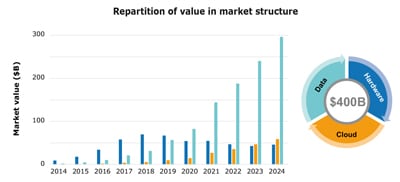
The Internet of Things (IoT) provides big opportunities for technologies. IoT device market will reach $46B in 2024, contributing to a total IoT market of $400B. FROM $9.5B IN 2014 TO $46B IN 2024, THE IOT DEVICE MARKET WILL REPRESENT CLOSE TO 15% OF ALL DATA PROCESSING


IoT devices offer huge potential for electronic component manufacturers, but this is clearly not where the value will stop. Most of the added value in IoT solutions will come from the processing of the generated data. In fact, the ratio between electronic components and data processing can reach 1:50 in certain long-term cases! This is easily understandable, since the main purpose of the IoT is to make sensing ubiquitous at a very low cost, resulting in extremely strong price pressure on electronic component manufacturers.


Nevertheless, the next five years will be extremely fruitful for device makers; the market should reach $70B by 2018, before decreasing. This period represents a key window in which manufacturers must seize the opportunity to grab a piece of the IoT business pie. The IoT is a multi-billion dollar market emerging from several different markets (i.e. industrial sensors, wearable electronics and home automation) which will see strong convergence in the next five years. Three industrial and service sectors will be integral to the valorization of this new market:


  • The electronics industry, which will manufacture the sensing devices

  • The communication and cloud data storage industry, which will handle data transmission, storage and processing

  • Service companies, which will valorize the data either through processing or by selling to a third party

Some companies have already started positioning themselves in these fields: for example, Oracle and Amazon are developing their cloud computing capabilities; Bosch Connected Devices and Solutions GmbH and STMicroelectronics have teams dedicated to the IoT; and Google and Facebook are continuously developing their data processing models while looking to acquire companies linked to data gathering. Of course, not all of them will be winners.


The short-term opportunity lies in the electronics industry. Indeed, very strong price pressure is expected for IoT devices, and strong volumes are expected but at very low cost. Even though the general electronics market will experience strong growth, it will be through decreased costs, increased manufacturing capabilities and reduced margins. This trend has already been seen in the MEMS field over the past few years, and will repeat itself in the future.


The same is to be expected for the cloud computing industry. Large investments in terms of data storage will be needed, but strong price pressure is expected, and an overall low value will be attributed to the physical data. Actually, the war on price has already begun between the major cloud computing companies, which are cutting data storage prices while growing their capabilities.


Meanwhile, on the data processing side, more and more information will be available, and at low cost. The more data, the higher the value, and all of this with low overall infrastructural investment. Service companies will be the big winners in this field. In order to secure some of this value, hardware and cloud companies will have no choice but to try and integrate themselves vertically in order to valorize themselves and the data they’ll be responsible for! As an example, we expect the overall IoT market to reach $400B in 2024, with $46B coming from hardware, $59B from the cloud and $296B from data processing.


IoT Device Market Report


IoT Device Market


This report provides a detailed analysis of applications, business models and technical challenges in order to understand the IoT market’s potential. Details of the new report, table of contents and ordering information can be found on Electronics.ca Publications’ web site.  View the report: Technologies & Sensors for the Internet of Things: Businesses & Market Trends 2014-2024.


IoT Device Market and Sensors Technologies for the Internet of Things